Fact-Checking Hand Anatomy: Are There Really 27 Bones in Every Human Hand?
Everyday language treats the wrist and the hand as two distinct biological territories. People wear watches on their wrists and rings on their hands. Human osteology recognizes no such division. The carpus belongs entirely to the manus, the anatomical Latin designation for the hand.
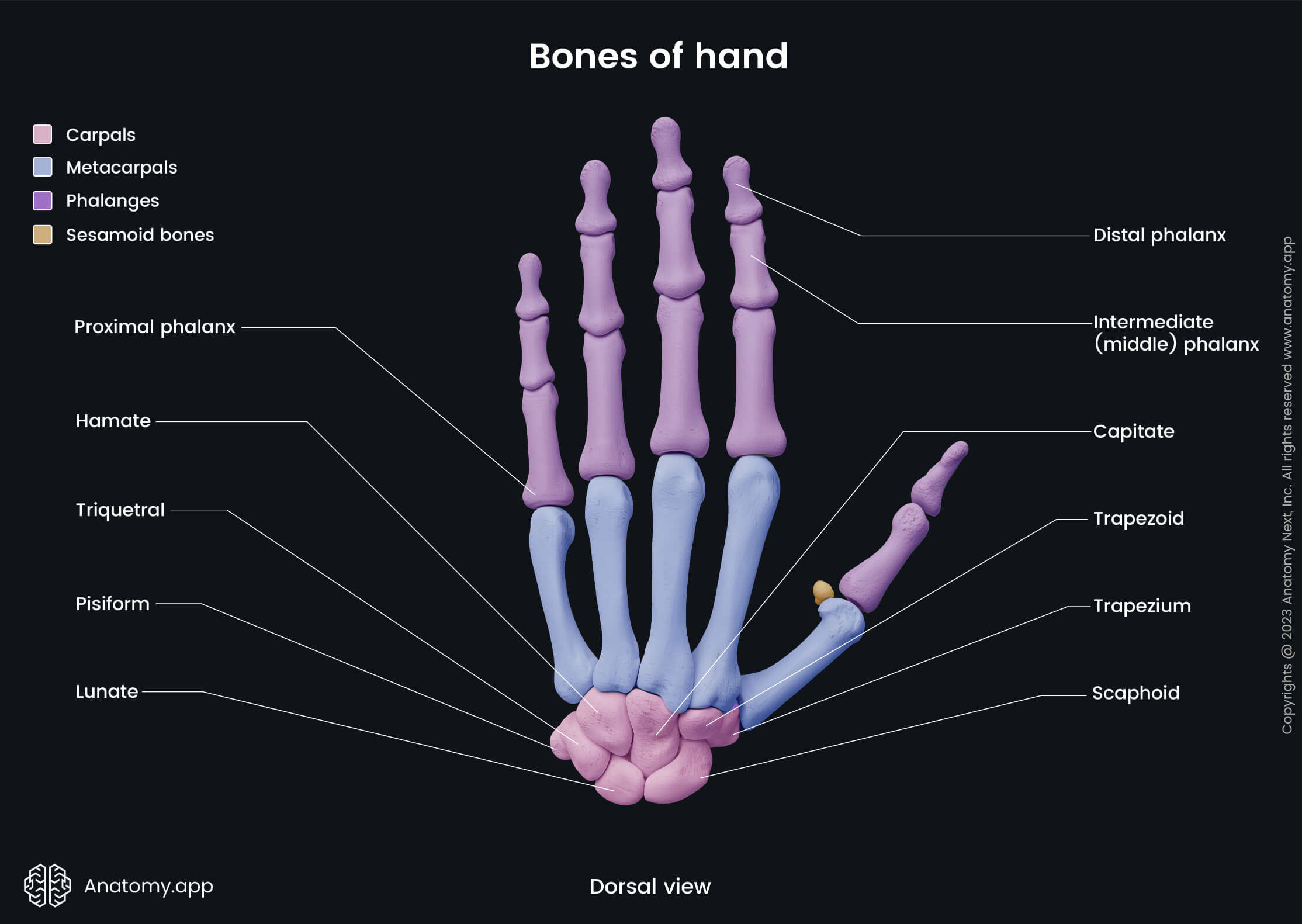
The eight carpals organize into two functional tiers:
- The Proximal Row: Moving from the thumb outward, this consists of the scaphoid, lunate, triquetrum, and pisiform. These articulate directly with the wrist joint surface.
- The Distal Row: Composed of the trapezium bone, trapezoid, capitate, and hamate, this tier anchors the palm's metacarpal bases.
This organizational link explains why wrist injuries fundamentally alter hand dexterity. A fracture to the boat-shaped scaphoid, frequently sustained during high-impact falls on outstretched palms, severely compromises grip strength. The scaphoid receives its arterial blood supply in a retrograde fashion, from distal to proximal. When a fracture disrupts this delicate pathway, nonunion or avascular necrosis can rapidly destroy the wrist's mechanical balance. The adjacent trapezium bone acts as the saddle joint seat for the first metacarpal. Without its unique concave-convex saddle geometry, the thumb could not execute the opposable sweep that distinguishes hominid tool use from primate quadrapedal locomotion.