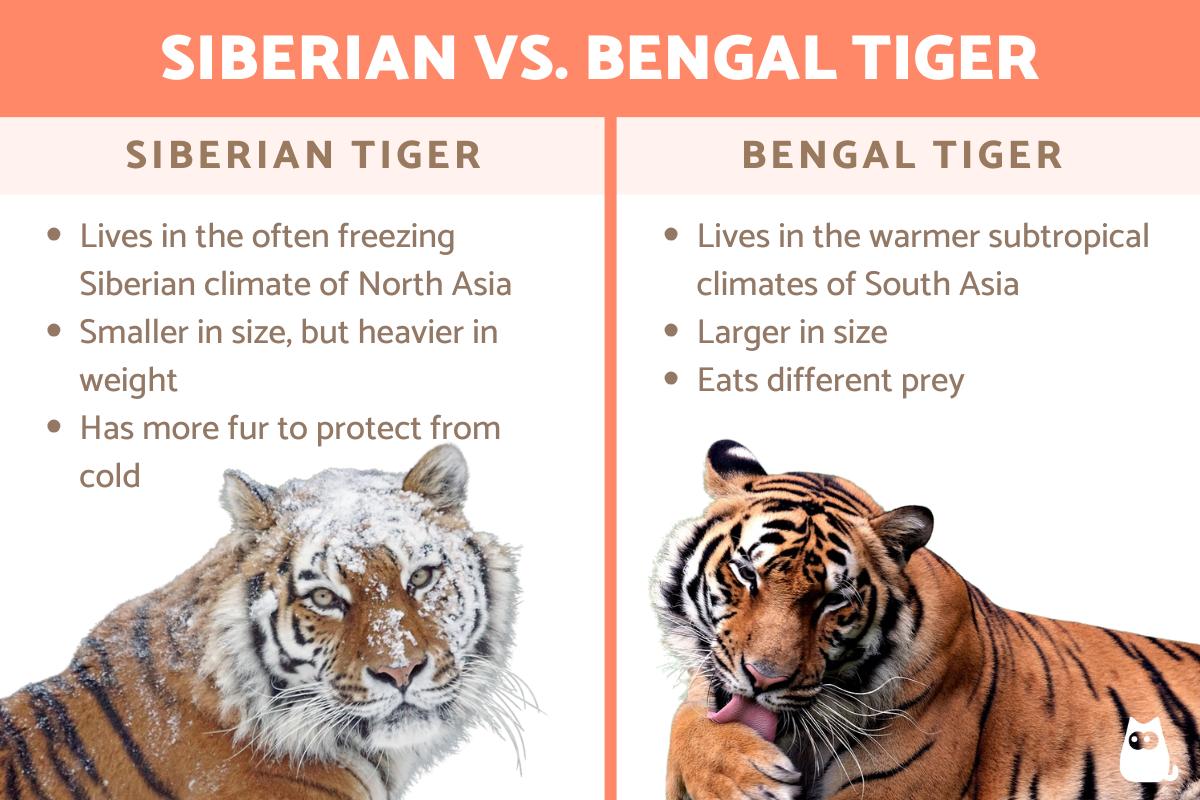
Siberian vs Bengal Tiger Complete Breakdown: Weight, Habitat, and Apex Dominance
Terrain dictates anatomy. The Amur tiger navigates the Russian Far East taiga, an unforgiving expanse of mixed cedar-broadleaf forests, snowbound ridges, and temperatures that routinely plunge below minus 40 degrees Celsius. Survival here requires specialized cold climate adaptations.
Siberian tigers grow a winter coat up to 100 millimeters thick along their bellies, complemented by a dense, woolly underfur that traps pockets of insulating air. They carry a thick layer of subcutaneous fat along their flanks and groin, acting as a biological buffer against freezing conditions. Their paws are broad, functioning as natural snowshoes to distribute heavy body weight over deep snowdrifts. Their coats feature wider, paler, and less dense striping, allowing them to disappear into snow-dusted birch thickets and rocky outcrops.
Move south to the Ganges-Brahmaputra delta, and the Royal Bengal tiger faces an entirely different crucible inside the Sundarbans mangrove habitat. Here, the landscape is defined by mudflats, tidal surges, and dense, tangled roots. Sundarbans tigers have adapted by shedding excess mass; males here often average only 110 to 130 kilograms, enabling them to navigate deep marine silt without sinking.
In mainland India's sal forests, the Bengal tiger exhibits a rich, reddish-orange coat patterned with razor-sharp, pitch-black stripes. This pattern breaks up the cat's massive outline in tall dry grass and dappled woodland shadows. Their short, coarse fur provides zero cold protection but facilitates rapid heat dissipation during blistering pre-monsoon heat waves where temperatures exceed 45 degrees Celsius.