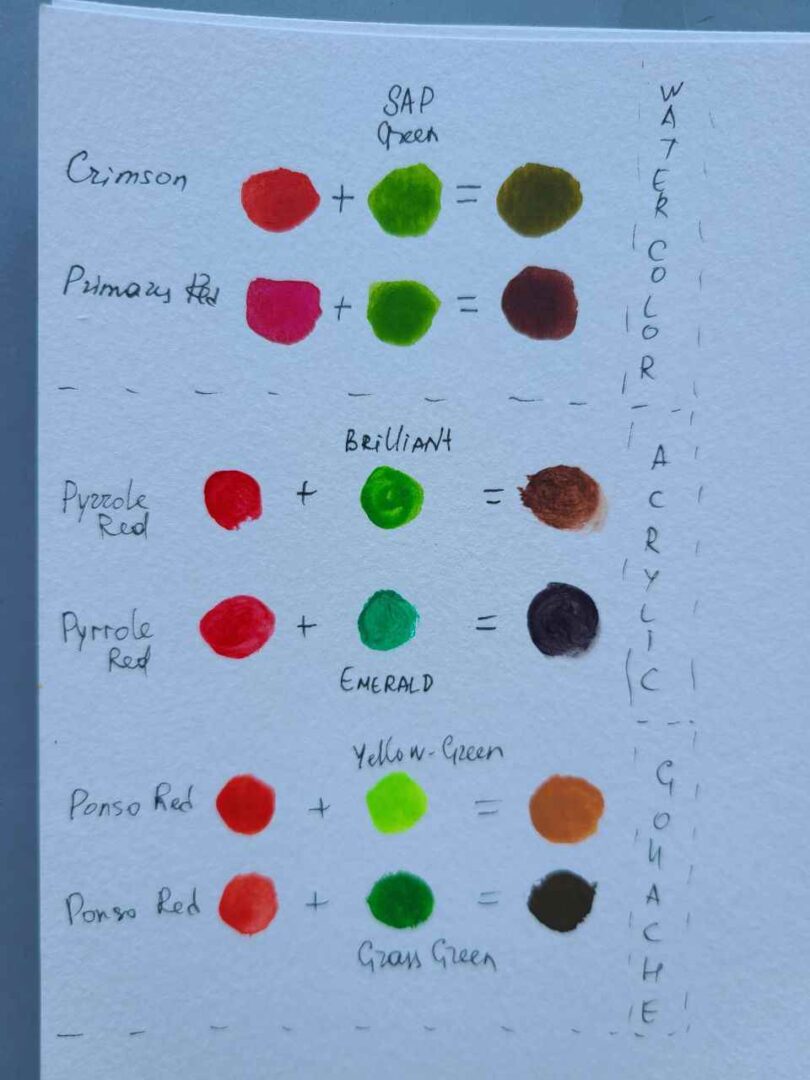
Why Mixing Red and Green Doesn't Make What You Think: the Optical Science Mystery
For more than two centuries, basic art education has relied on the historical RYB color wheel popularized by Johann Wolfgang von Goethe and early craft academies. In this 18th-century model, red, yellow, and blue are designated as pure primaries, placing red and green across from one another as complementary colors.
While the RYB schema works well for mixing basic earth pigments, it fails as a rigorous scientific model. It conflates biological sensations with chemical properties. Research highlighted by Earth.com on human chromatic tuning shows that evolutionary pressures shaped human color pathways around natural daylight shifts and ripe vegetation, anchoring neural processing across two specialized balancing channels rather than arbitrary trios of paint tubes.
The visual system processes signals through opponent-process theory, a neurobiological architecture identified by physiologist Ewald Hering. Retinal ganglion cells calculate color through opposing neural pathways: a red-versus-green channel, a blue-versus-yellow channel, and a black-versus-white luminance channel. When a single visual field stimulates the red and green sensors with equal intensity, the red-green opponent channel cancels out to net zero. With no chromatic bias left in that specific channel, the visual brain falls back onto the luminance and yellow axes, perceiving clean yellow light.